Compare the Best HVAC Course in Chennai with Real-World Outcomes and Future-Ready Training.
If you’re an engineering graduate (Mechanical, Civil, or Electrical) or a working professional aiming to build a career in HVAC Design and MEP systems, this guide is your roadmap to finding the best HVAC course in Chennai.
We analysed Chennai’s leading HVAC training institutes on five factors:
curriculum quality, trainer expertise, placement support, student reviews, and technological innovation—including the integration of AI in HVAC design.

Contents
🌡️ Why HVAC Training Is in High Demand in 2025
India’s HVAC (Heating, Ventilation, and Air Conditioning) sector is on track to grow at a 7.5% CAGR (2020–2025) according to ResearchAndMarkets.com.
This surge comes from rising urbanization, the expansion of green buildings, and increasing demand for sustainable design practices.
Chennai, as one of India’s leading MEP hubs, offers strong career prospects for HVAC engineers in design consultancies, construction companies, and facility management sectors. Completing an HVAC Course in Chennai equips you with job-ready technical and software skills and in the case of ACTMEP, it also gives you an edge with AI-driven design tools and placement mentorship unmatched by other institutes.
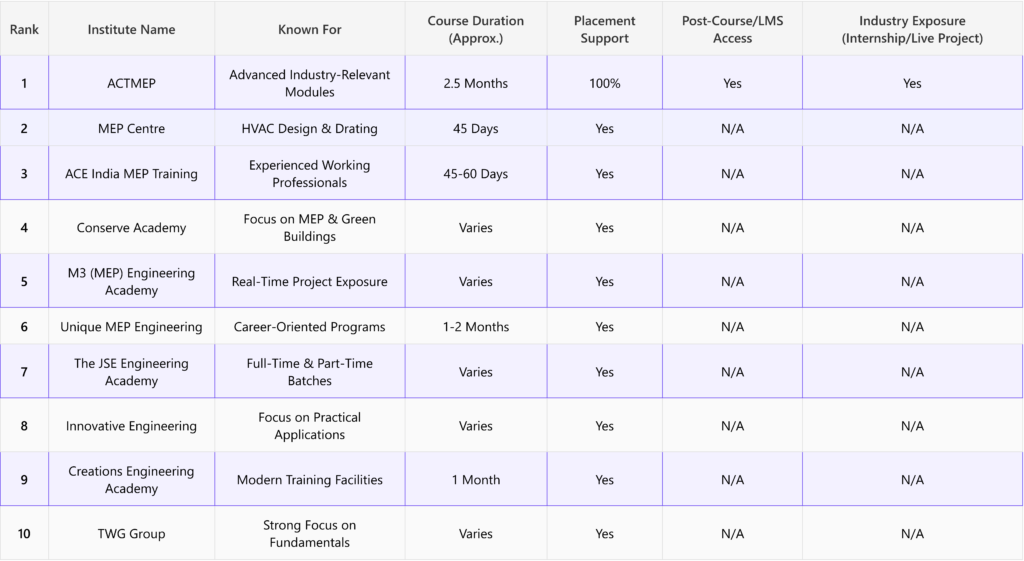
Quick Comparison of Chennai’s Best HVAC Institutes
ACTMEP — India’s First HVAC Course with AI Integration (Best Overall)
Where Engineering Meets Artificial Intelligence to Redefine HVAC Design Careers
ACTMEP is redefining HVAC education in India by combining core engineering principles with Artificial Intelligence.
This makes it the best HVAC Course in Chennai for engineers who want to master both design fundamentals and AI-driven automation a combination that no other training institute currently offers.
🤖 AI Meets HVAC Design: The Future Is Now
Traditional HVAC design relies on manual calculations and software modelling.
ACTMEP’s AI-integrated curriculum introduces intelligent automation in:
- Heat Load Analysis: AI algorithms predict loads faster and more accurately.
- Duct Layout Optimisation: Smart routing reduces energy loss and pressure drops.
- Energy Modelling: AI simulations forecast performance before installation.
- Predictive Maintenance: Students learn how sensors and data models anticipate faults.
- AI-Enhanced HAP & Revit MEP Workflows: Reduce design time and boosts precision.
“Engineers who learn to integrate AI with HVAC design will define the next decade of MEP innovation.”
— Eng. Rajesh Kumar, Lead Trainer at ACTMEP
What Makes ACTMEP the Best Choice?
1. Learn from the Masters :
- Top Teachers: Your trainers aren’t just professors; they are experienced engineers who have worked in the industry for over ten years, designing and installing big projects. They teach you what actually works on site.
- Master the Tools: You get intense training on all the essential, high-tech computer programs that engineers use every day. This includes:
- AutoCAD: For making technical drawings.
- Revit MEP: For creating advanced 3D models of the building systems (called BIM).
- Carrier’s HAP: A special software to calculate exactly how powerful the AC needs to be for any room.
2. Real-World Experience (Practical Application):
- Guaranteed Interview Internship: ACTMEP gives you a unique internship where you work on actual building plans. This is not just practice—it’s a major resume boost, and they guarantee you job interview opportunities once you complete it.
- Live Project Work: You get to design the HVAC system for at least two complete commercial or residential projects. This gives you a strong, practical portfolio that impresses hiring managers.
3. Total Career Support
- Dedicated Job Help: They have a special placement team that helps you with everything: building a professional CV, practising for tough interviews (mock interviews), and connecting you directly with companies that are looking to hire.
- LinkedIn Placement Program (L-PAP): They help you set up an outstanding LinkedIn profile, and they coach you on how to use it to stand out and get calls for the best-paying HVAC Design Engineer jobs.
- Flexible Study Access (LMS): You get long-term access to their online Learning Management System. This means you can go back and watch the recorded lessons and check notes anytime, even after your course is finished, to refresh your memory.
ACTMEP’s HVAC Design Syllabus: The Gold Standard Curriculum for 2025
| Module No. | Module Name | Key Learning Outcomes |
|---|---|---|
| Module 1 | HVAC Fundamentals | Basics of thermodynamics and modes of heat transfer. The vapor compression refrigeration cycle. Understanding sensible heat, latent heat, and standard units. Introduction to key industry standards (ASHRAE, ISHRAE, SMACNA). |
| Module 2 | Psychrometrics (The Science of Air) | Basics of thermodynamics and modes of heat transfer. The vapor compression refrigeration cycle. Understanding sensible heat, latent heat, and standard units. Introduction to key industry standards (ASHRAE, ISHRAE, SMACNA). |
| Module 3 | Heat Load Calculation | The most critical module for an HVAC designer. Conducting building surveys and understanding architectural drawings. Calculating cooling and heating loads from various sources (walls, roofs, glass, lights, occupants). Manual calculations using standard forms (e.g., E-20). Software-based calculations using industry-standard tools like Carrier’s HAP (Hourly Analysis Program). |
| Module 4 | Air Distribution System Design | Types of ducts, materials, and insulation. Duct sizing methods (e.g., the Equal Friction Method). Calculating static pressure for fan/blower selection. Selection of grilles, diffusers, and other air terminals. |
| Module 5 | Hydronic System Design (Chilled Water Systems) | Understanding different types of chillers and cooling towers. Chilled water pipe sizing and layout. Calculating pump head and selecting the right pumps. Valves, fittings, and accessories used in piping systems. |
| Module 6 | HVAC Equipment Selection & Drafting | How to read and use a psychrometric chart. Understanding key properties: Dry Bulb Temperature (DBT), Wet Bulb Temperature (WBT), Relative Humidity (RH), and Dew Point. Analysing air conditioning processes like cooling, dehumidification, and heating. |
| Module 7 | HVAC with AI Integration | AI-powered HVAC design, ChatGPT for engineering tasks, Prompt engineering for HVAC, AI-driven system optimisation, Future of smart HVAC systems |